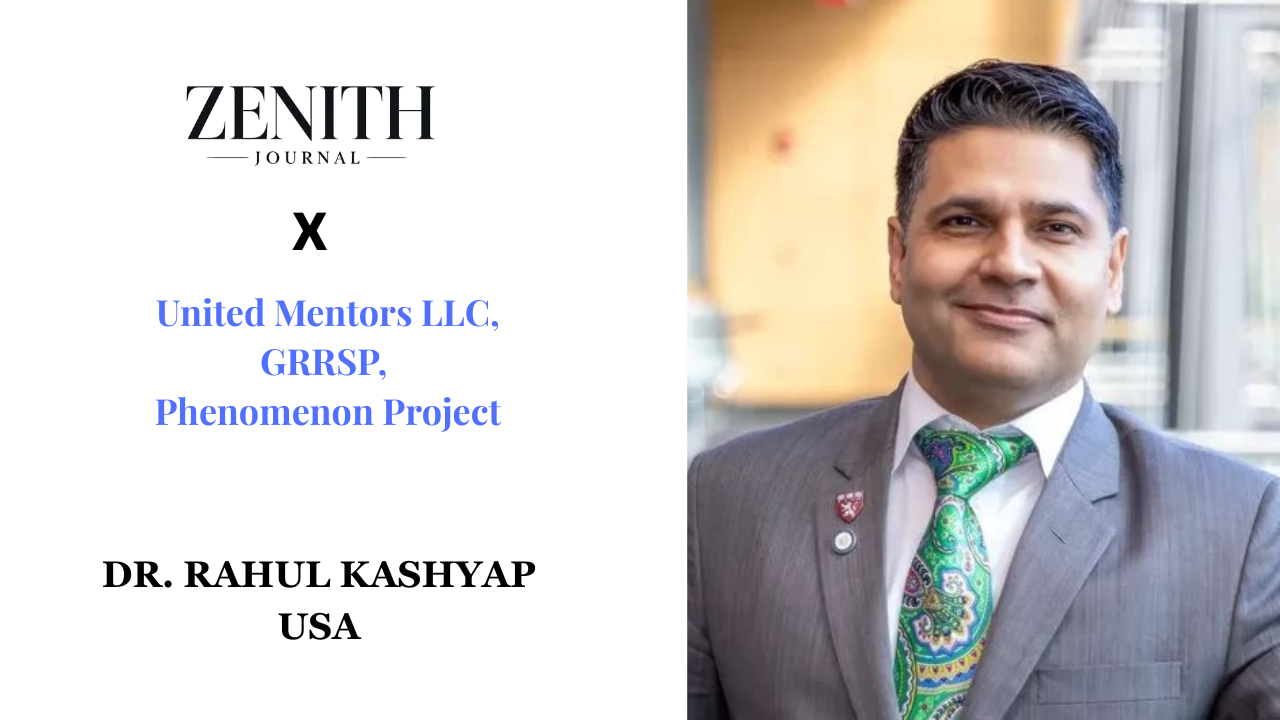
Why Mentorship May Be the Most Undervalued Force in Modern Medicine – A Perspective from Dr. Rahul Kashyap
In an era where medicine is increasingly shaped by technology, data, and specialization, one of the most powerful drivers of progress often remains underemphasized — mentorship. While research output, clinical excellence, and innovation continue to define modern healthcare systems, the transmission of knowledge through human relationships still plays a foundational role in shaping future leaders.
Dr. Rahul Kashyap’s career offers a compelling lens into this dynamic. As a physician-scientist, researcher, and educator, his work extends beyond individual achievement into something more enduring — the development of others. Over decades, his contributions have spanned clinical research, academic publishing, and healthcare innovation. Yet, one consistent thread runs through it all: a focus on enabling people to grow.
This perspective challenges a common assumption within professional environments — that success is primarily individual. In reality, progress in fields like medicine is often collective, cumulative, and intergenerational. Knowledge builds not just through discovery, but through guidance, critique, and shared experience.
You may check his mentorship program: GRRSP.
Mentorship as a Multiplier, Not a Support Function
In many institutions, mentorship is treated as a secondary responsibility — something that complements core work rather than drives it. Dr. Kashyap’s approach suggests the opposite. Mentorship, when done effectively, acts as a multiplier. It accelerates learning, reduces avoidable mistakes, and builds confidence in ways that formal training alone cannot achieve.
This becomes especially visible in high-stakes environments such as clinical medicine and research, where decisions carry significant consequences. In such contexts, guidance is not merely helpful — it is essential. The ability to navigate uncertainty, interpret data, and make informed decisions often develops through exposure to experienced perspectives.
At the same time, mentorship is not a one-way transfer of knowledge. It is a dynamic exchange. Younger professionals bring fresh perspectives, challenge assumptions, and introduce new ways of thinking. This interaction creates an environment where both mentor and mentee evolve.
“Growth in complex fields is rarely linear. It is shaped by people who help you see what you cannot yet see yourself.”
The Role of Failure in Building Expertise
Another dimension of Dr. Kashyap’s perspective centers on how professionals engage with failure. In structured environments, failure is often perceived as something to minimize or avoid. However, in practice, it serves a different function. It reveals limitations, highlights gaps, and provides direction for improvement.
Repeated exposure to rejection — whether in research proposals, academic submissions, or career opportunities — can be discouraging. Yet, it also creates a feedback loop. Each setback offers insight into what needs refinement. Over time, this process builds resilience and sharpens judgment.
In this sense, failure is not an interruption to progress. It is part of it. The ability to reinterpret setbacks as data points rather than endpoints becomes a defining factor in long-term success.
Beyond Clinical Boundaries: Expanding Intellectual Inquiry
While Dr. Kashyap’s foundation lies in medicine, his intellectual pursuits extend beyond traditional clinical boundaries. This is evident in The Phenomenon Project, a multidisciplinary initiative that explores how communities, cultures, and systems sustain influence across generations.
The project reflects a broader question — what drives continuity and excellence over time? Rather than focusing solely on outcomes, it examines underlying structures: patterns of behaviour, shared values, and the transmission of knowledge across generations.
This shift from outcomes to systems mirrors a growing recognition across disciplines. Complex problems cannot be understood through isolated data points alone. They require a deeper analysis of the structures that produce them.
You may check his Phenomenon Project here.
Staying Relevant in a Changing Landscape
The pace of change in healthcare and research continues to accelerate. New technologies, evolving methodologies, and shifting global priorities require professionals to adapt continuously. In this environment, staying relevant is not about maintaining existing knowledge, but expanding it.
Dr. Kashyap’s approach emphasizes reinvention. This includes engaging with new ideas, collaborating across disciplines, and remaining open to perspectives that challenge established thinking. It also involves a commitment to lifelong learning — not as a formal requirement, but as a mindset.
Collaboration plays a central role in this process. Diverse teams bring varied experiences, which can lead to more robust solutions. In contrast, isolated thinking often limits innovation.
Advice for the Next Generation of Professionals
For those entering the field, the guidance is both simple and demanding. Stay curious. Seek knowledge actively rather than passively. Engage with mentors who can provide perspective and challenge assumptions.
Equally important is the willingness to take risks. Not reckless risks, but informed ones. Opportunities often emerge in uncertain spaces, and navigating them requires both confidence and adaptability.
Finally, understand that growth is not immediate. It is cumulative. The skills, insights, and relationships developed over time form the foundation for long-term impact.
A Broader Perspective on Impact
In professional narratives, impact is often measured through visible achievements — publications, positions, awards. While these markers are important, they represent only part of the picture. A deeper form of impact lies in what is sustained over time.
Mentorship, intellectual contribution, and the ability to shape thinking across generations create effects that extend beyond individual careers. They influence systems, institutions, and communities in ways that are not always immediately measurable.
Dr. Rahul Kashyap’s work reflects this broader understanding. It is not limited to what he has achieved, but extends to what continues through others — ideas, knowledge, and the capacity to think more critically and act more effectively.
“The most meaningful influence is not what you build alone, but what continues through others.”